I work at the intersection of low-level systems engineering and neurotechnology / computational neurocognition. My core interest is understanding biological computation—how neural networks process, store, and route information.
While developing a continuous-time synapse prediction model for the C. elegans connectome, I hit a major bottleneck with existing temporal Graph Neural Networks: modeling continuous-time synaptic interactions and spike intervals caused severe memory explosion due to recursive graph traversals. To solve this, I created RT-GNN (Time-Parameter for GNN), using continuous-time complex rotation operators to track synaptic state transitions in closed form with logarithmic scaling.
My systems work is also grounded in real-time simulation and game engines:
- CVRS (Clustered Vertex Representative Search) — a sortingless spatial pathfinding architecture implemented in C for Unreal Engine 5, eliminating priority-queue bottlenecks and bounding memory during multi-agent navigation.
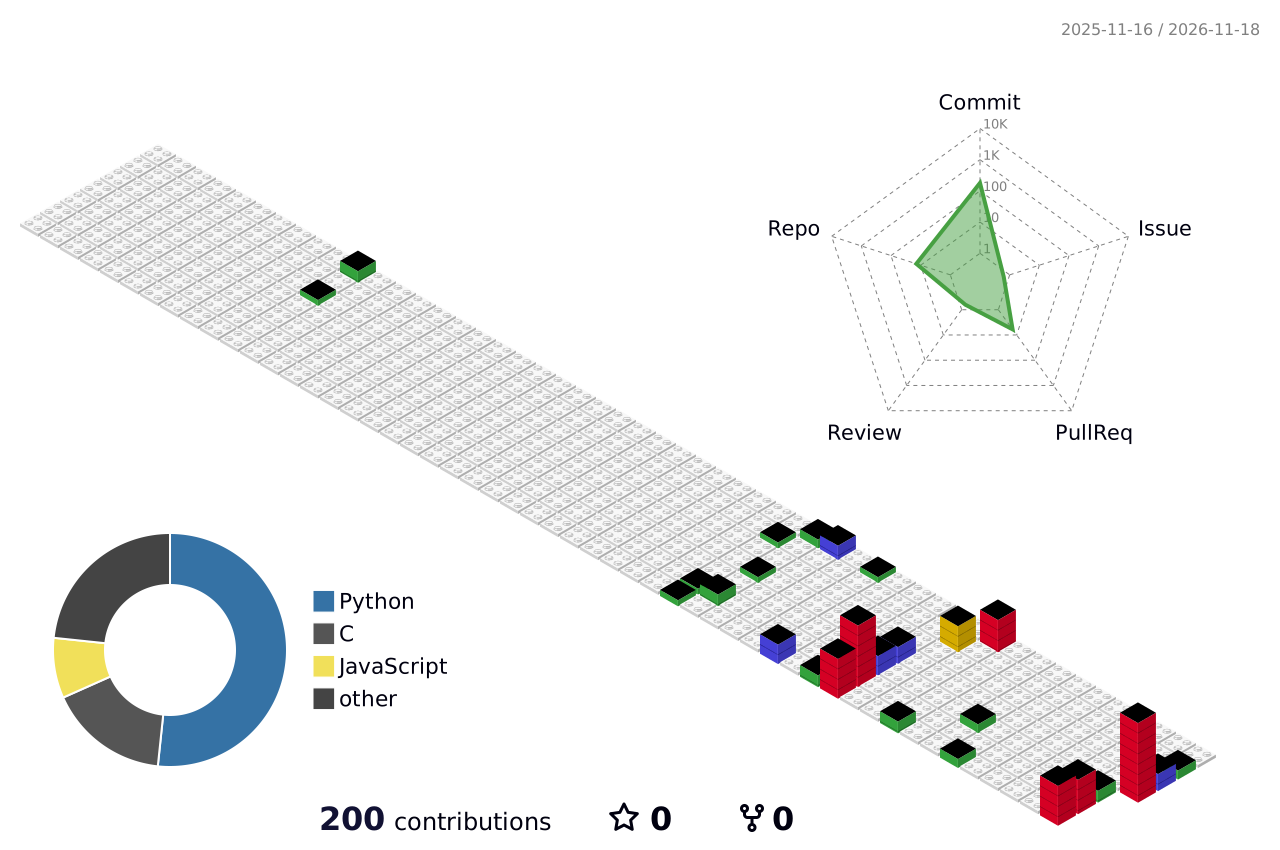
I primarily program in Python (machine learning, PyTorch, PyG) and C (memory optimization, data structures), with working experience in Java, JavaScript, SQL, and Unreal Engine Visual Scripting (Blueprints). Prior to implementation, I use Figma and Miro for system architecture mapping and collaborative workflows.
- Python (Primary / Major) — ML pipelines, PyTorch, PyG, continuous-time graph models, statistical modeling
- C (Next Major / Systems) — Low-level memory management, high-performance algorithm implementation (CVRS), spatial data structures
- Java — Object-oriented architecture, backend services
- JavaScript — Full-stack web applications, APIs
- SQL — Relational database modeling, query optimization
- Unreal Engine Visual Scripting (Blueprints) — Gameplay logic, event systems, simulation mechanics
- Deep Learning & Neurotech: Continuous-Time Graph Neural Networks (RT-GNN), Synapse Prediction (C. elegans Connectome), CNNs, ANNs, State-Space Models
- Classical ML & Statistics: Linear/Logistic Regression, Decision Trees, Random Forests, KNN, K-Means Clustering, Hierarchical Clustering
- Time-Series & Forecasting: ARIMA, Multi-Harmonic Encodings
- Libraries: PyTorch, PyTorch Geometric, Scikit-Learn, NumPy, SciPy, pandas, Matplotlib
- Languages: C++
- Design & Prototyping: Figma, Miro, Canva
- Infrastructure: Git, Linux, Windows, Docker, Agile / Scrum
Continuous-time temporal graph model motivated by C. elegans synapse prediction.

- Origin: Designed to solve the continuous-time memory bottleneck when modeling synaptic connections in C. elegans.
-
Closed-Form Continuous-Time Rotation: Bypasses recursive graph expansions through complex state operators
$T_{\Delta t}(z) = z \cdot \exp((-\lambda + i\omega)\Delta t)$ , maintaining the semigroup property$T(a) \circ T(b) = T(a+b)$ . -
Logarithmic Parallel Prefix Scans: Replaces sequential Backpropagation Through Time (BPTT), cutting scaling from
$O(K)$ down to$O(\log K)$ via associative prefix scans. - Benchmark Performance: Scored 0.4755 ± 0.0215 Test MRR on Stanford TGB Wikipedia benchmarks while processing over 19,300+ edges/sec on CPU without label leakage.
- Verification: Backed by 35 automated test gates certifying causality, contractive decay, and autograd gradient preservation.
High-performance spatial pathfinding architecture for multi-agent simulation.

- Bypassing the Sorting Barrier: Inspired by Ran Duan et al.'s research on sortingless shortest-path algorithms, CVRS eliminates the priority-queue (min-heap) sorting barrier that causes memory explosion in traditional Dijkstra and A* searches.
- Hierarchical Representative Partitioning: Partitions dense spatial graphs into clustered representative vertices, bounding the active search space to local sub-graphs and cutting per-agent memory footprint by over 70%.
- High-Performance C Engine: Implemented custom data structures in low-level C using Data-Oriented Design (DOD) to maximize cache locality under heavy multi-agent concurrency.
- Unreal Engine 5 Integration: Designed for direct integration with Unreal Engine navigation mesh runtimes without frame-rate drops.
Streaming data ingestion pipeline feeding weather feeds into deep learning models.
- Streaming pipeline ingesting real-time global weather data into planetary AI models (GraphCast architecture) for risk forecasting.
Full-stack review, rating, and socialization web platform.
- Designed user flows and wireframes in Figma and built full-stack web application with relational SQL database schema.