





AI engineer. I build intelligent systems and actually ship them — trading apps, desktop widgets, and developer tools that real people use.


QML + C++ · GPL-2.0+ · published on the KDE Store · Repository
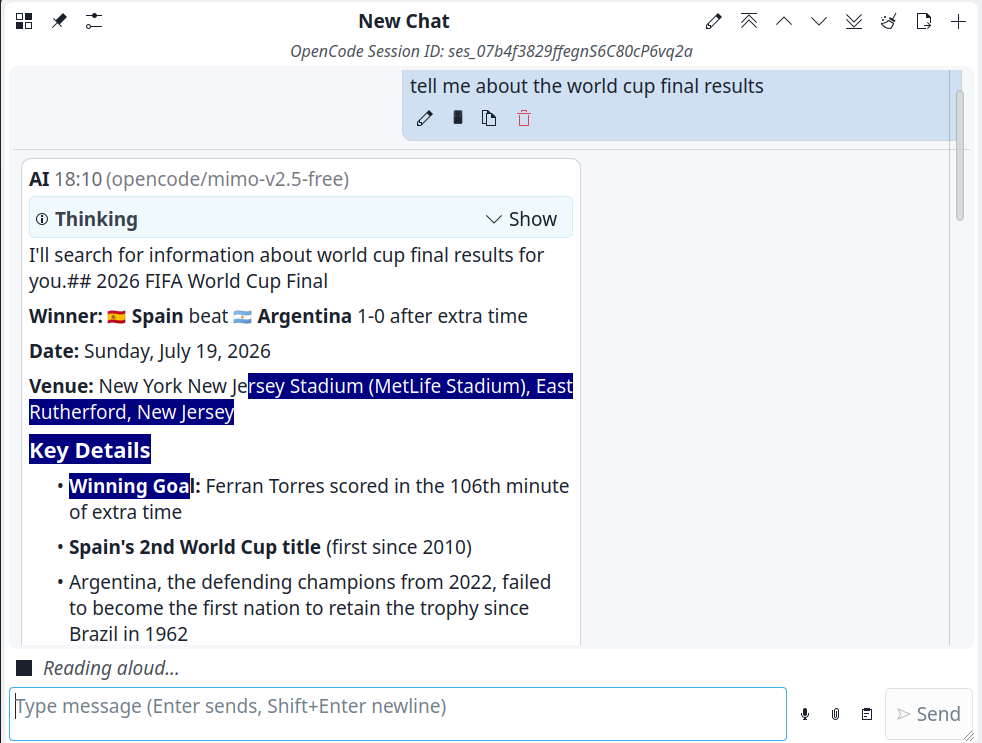
A native KDE Plasma 6 widget that turns your panel into a complete AI assistant — cloud or fully offline — with voice, memory, scheduling and developer tooling built in rather than bolted on.
- Cloud or fully offline — 15+ providers out of the box (OpenAI, Claude, Gemini, DeepSeek, Groq, OpenRouter, Mistral) plus local models through Ollama, LM Studio, llama.cpp and LiteLLM. Providers load their model lists dynamically (NVIDIA NIM pulls in 118 models on connect), and anything else can be wired in through the built-in OpenCode bridge.
- Local voice mode (beta) — talk hands-free with Whisper speech-to-text and Kokoro text-to-speech running on your own machine, CPU or CUDA-accelerated. Highlight any passage and only that gets read aloud, with a global stop button to interrupt.
- Background task scheduler — recurring prompts through systemd user services: cron-style schedules for daily briefings, rate checks and automated code reviews — plus a live resource monitor with per-process kill buttons.
- Persistent AI memory — remembers facts about you across sessions, with a prompt-context preview so you always see exactly what gets sent.
- OpenCode developer bridge — run code, search the web and drive agent tasks straight from your panel, with custom endpoints and providers.
- Drag & drop everything — images, PDFs, CSVs, Word documents and text files; a file alone is a valid message, and heavy processing runs in background threads so the desktop never freezes.
- Built for daily use — reusable prompt templates (
/news,/review…), quick-jump navigation through long threads, message rewind (edit an older question and the conversation restarts from there), chat export to Markdown or text, resizable popup, auto-saving settings. - Trusted handling — API keys encrypted in KWallet (with a safe fallback), defensive DBus and config-path handling to prevent shell-injection issues, and a codebase that passes
qmllintwith zero warnings. - Installs in seconds — from the widget browser, a
.plasmoidviakpackagetool6, or from source; optional system tools (poppler, pandoc) are detected and explained in-chat instead of failing silently.
100% local-first · TypeScript · published in the Obsidian community plugin store · Repository
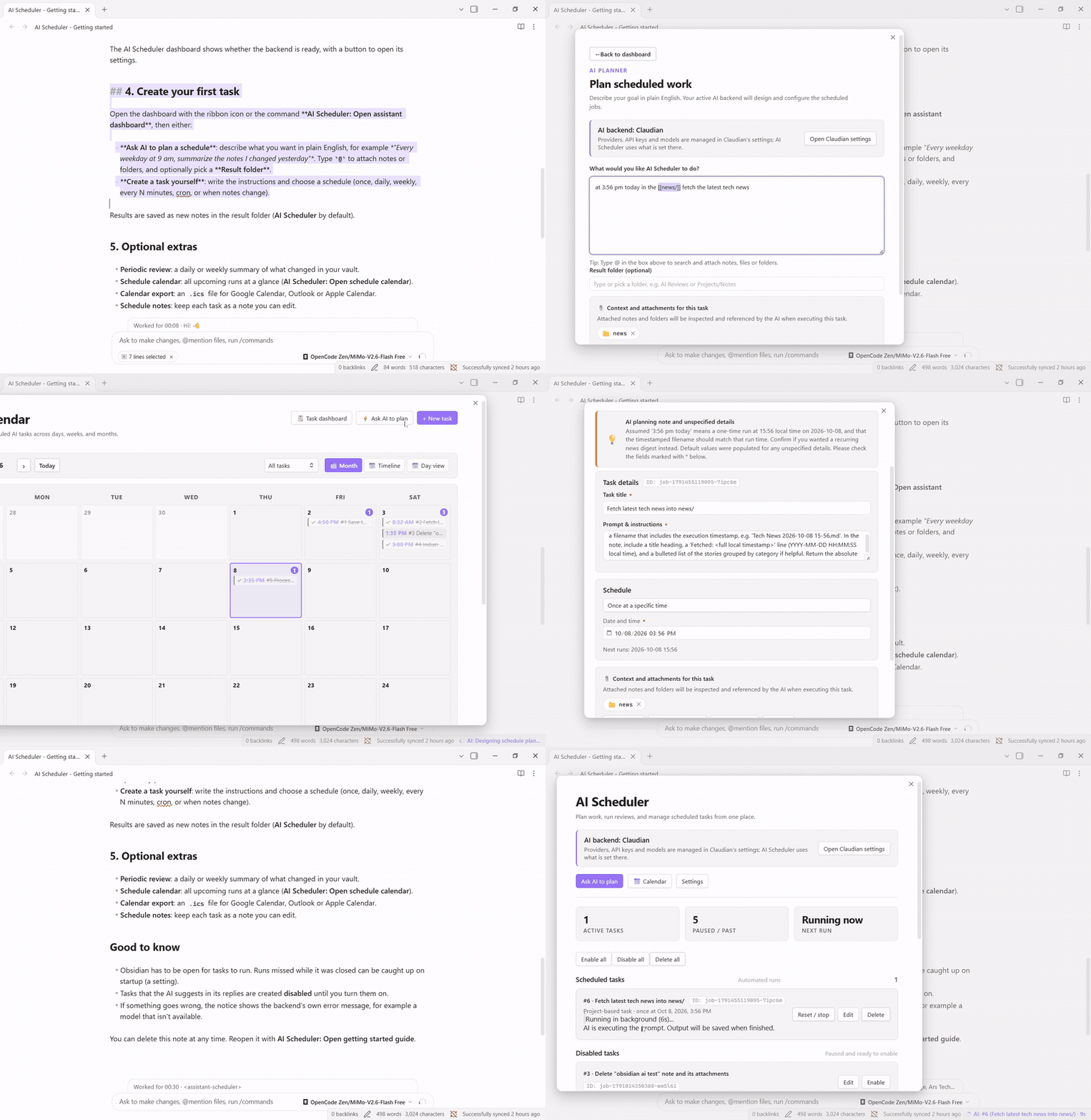
Describe a task in plain English, give it a cadence, and let your vault run itself — summaries, reviews and reports appear while you work or sleep.
- Describe it in plain English — the built-in AI planner turns "every Friday afternoon, summarize this week's project notes" into a fully configured job; attach any note or folder with
@. - Every schedule type you'll ever need — daily, weekly, every N days/weeks/months, intervals, full 5-field cron, multi-rule weekdays, one-shot, vault-change triggers (with a cooldown) and chained tasks that run after another finishes — each with an optional max-iterations cap.
- Drives the AI you already use — works with Claudian, Oh My Claudian and Obsidian Copilot 3.x/4.x; the plugin owns scheduling and execution, your existing setup owns the models and keys. No extra accounts, no telemetry.
- Periodic reviews — gathers everything you changed since the last run and writes a structured report (progress, open loops, recommendations) into your vault.
- Real task plumbing —
{{date}},{{changed_notes}}(up to 50 links),{{last_run}},{{previous_result}}and more variables; retries (up to 5), run time limits, "only run when something changed", a 20-run history per task, quiet hours and pause (1 h / 4 h / tomorrow / until resumed). - Results land where you want — a new note per run, replace one note, append to one note (optionally under a heading), or today's daily note; schedule notes stay vault-synced as Markdown with YAML frontmatter, and everything exports/imports as JSON.
- A real dashboard and calendar — month, agenda and day views of upcoming runs; live timers for running tasks, an activity log, tag search and sorting, trash & restore, plus an
.icsfeed you can subscribe to in Google, Outlook or Apple Calendar. - Ships with 8 starter templates — morning plan, daily summary, weekly review, inbox triage, action items, flashcards, link suggestions, monthly reflection — each opens pre-filled in the task editor.
- Built like real software — a dependency-free, DST-safe cron engine tested against edge cases, a 15-second dispatcher, strict TypeScript, ESLint (Obsidian ruleset) and a smoke test against a mocked Obsidian API.
TypeScript · FastAPI + React · web, Electron & Linux AppImage · Repository
A complete trading journal and analytics workbench that runs on your machine — log trades, study replays, and let AI (local or cloud) help you find the pattern behind the P&L.
- The full review loop — structured trade logging, calendar P&L, a replay-analytics lab and a screenshot/tape-read archive with voice and video notes — everything you need to review a trading week honestly.
- Your strategy, your fields — a strategy tester plus a custom logger builder, so you define what each strategy's entries look like instead of surviving someone else's template.
- AI chat on your terms (beta) — Ollama, LM Studio/vLLM/llama.cpp, OpenAI, Anthropic, Gemini, Cerebras, Groq, NVIDIA NIM, OpenRouter and Cloudflare Workers AI — pick fully local, fully cloud, or mix.
- Ships as real software — FastAPI backend (SQLite or MySQL, switchable at runtime), a React + Vite + TypeScript SPA, an Electron dev shell, and production Linux AppImages with a PyInstaller-packaged backend.
- Documented in-app — versioned docs with an indexed TOC, a REST API overview, a robustness checklist and runtime-editable storage paths.
Python · Django 5 · Backtrader + Optuna · Repository
An algorithmic-trading lab: write a strategy in plain English, get real Backtrader code, optimize it like a quant, and judge the results on a high-precision chart.
- Plain English → Backtrader — Llama 3.3 generates compilation-ready strategy code and drops it straight into a live editor.
- Refine by talking — ask for "a trailing stop-loss of 2%", or hand-edit the code; every change re-runs against real market data (yfinance) and re-charts.
- Optimize like a quant — Optuna Bayesian parameter sweeps with composite objectives — your own weights across Sharpe ratio, total return and max drawdown.
- Judge results visually — TradingView Lightweight Charts with high-precision buy/sell markers overlaid, next to a Buy & Hold benchmark so you can see whether the strategy earns its keep.
- Nice touches — SQLite persistence, light/dark themes, and five trading-timezone presets (New York, London, UTC, Tokyo, Kolkata).
TypeScript · Bun · MIT · Repository
A coding agent in the same family as OpenCode and Claude Code — but with quantitative finance and algorithmic trading wired into its bones.
- Domain knowledge included — a built-in reference library for Backtrader, Pine Script v6, yfinance, Dukascopy tick data, and financial CSV/Parquet handling, so it understands the code it's writing.
- Any brain — Anthropic, OpenAI, Google or local models, with tools for file editing, shell, web search and MCP servers.
- Codebase-aware — LSP diagnostics plus semantic code search, so it navigates your project instead of guessing.
- Proper terminal citizen — a themed TUI, per-project
straiker.jsonconfig, and env-var overrides (STRAIKER_CONFIG,STRAIKER_CONFIG_CONTENT) for scripts and CI.
Laravel 13 + React 19 · Repository
Give it a premise and it hands back a finished video — script, storyboard, generated visuals, measured voice-over, subtitles and an ffmpeg-rendered MP4.
- Two gears — short videos (≤5 min) in a single pass, or stories up to 4 hours written chapter-by-chapter with checkpoints: kill a run at chapter 40 of 60 and it resumes exactly there; rewrite one chapter without touching the rest.
- Survives real workloads — sliding-window media concurrency (6 parallel jobs by default) so a 1,000-beat story never floods the queue, and chapter-aligned render chunks that concatenate without re-encoding.
- Provider ladder everywhere — text and images across OpenAI, Anthropic, Gemini, Groq, OpenRouter, Replicate and keyless Pollinations; video via Fal/Replicate; TTS via ElevenLabs, OpenAI or Google Translate — all with automatic fallback.
- Secrets stay server-side — API keys never reach the browser; the UI only shows the last 4 characters.
- Engineered with receipts — 171 hermetic tests (no test touches the internet), typecheck + Pint in the pipeline, and an honest
AUDIT.mdof known limits.
Laravel + agentic AI · under active development · Repository
A journal, research workspace and personal coach for forex and prop traders — with an in-house agent platform (ForgeAI) doing the heavy lifting.
- One place for trading — journaling, research and coaching in a single workspace built for forex and prop-firm workflows.
- ForgeAI inside — an agent layer with an intent registry, 29 typed domain commands, a multi-agent supervisor and streaming responses, behind a gateway with provider capability fallback.
- Agentic UI done properly — @mention agents, batch mutation cards, and a 15-minute undo window on everything the AI changes.
- Three AI modes — drive it straight from raw APIs, hand it to an OpenCode agent, or run it through the Pi agent integration — one doc per mode in the repo.
- Operator tooling — a
fe:*/fe:ai:*CLI with AI mode/model switching, parameter tuning and JSON scripting, plus one-shot dev scripts for Windows, Linux and containers (Docker + Compose included). - Security & durability — ToolGate permission budgeting, durable workflows that survive restarts, and a hybrid PHP/Vitest test suite enforced with PHPStan and Pint in CI.
- Engineered with receipts — a versioned docs set (architecture spec, CLI reference, QA checklists, weekly progress audits) that tracks every claim to a commit — and states its gaps honestly: the alpha is not release-certified yet.
- Next generation in progress — a free-first, self-hostable rebuild (FastAPI + React) is already underway.
Kotlin · Android 5.0+ · built for TV sticks · Repository
An Android TV screensaver that turns an idle screen into an audio-reactive light show or a photo gallery — tuned to run on the cheap TV sticks everyone actually owns.
- 18 audio-reactive visualizers — Yantra, Aurora, Lattice, Mycelium, FlowField, Waterfall and friends, rendered in OpenGL ES 2.0 with a two-pass bloom pipeline; beat detection adapts to the genre (electronic/rock/classical frequency weighting) and the effects hold 60 FPS on low-end hardware.
- Photos from anywhere — Google Drive and OneDrive via OAuth device flow (no Google Play Services needed, which is why it works on Huawei), Dropbox, self-hosted Immich, Nextcloud over WebDAV, Synology NAS or local storage — all sources can run at once and merge into one shuffled stream.
- Survives bad Wi-Fi — a 200-image / 300 MB offline cache takes over automatically whenever a source is unreachable.
- The details matter — Ken Burns motion that always settles centered, six transitions, EXIF auto-orientation, clock + weather overlays, active-hours scheduling, and a visualizer you can run semi-transparent over your photos.
- Feels native — registers as a system Dream Service, remote-control shortcuts while running (←/→ effect, ↑/↓ intensity), preview mode from settings, and an in-app updater with stable/dev channels.
- Privacy-first — credentials live on-device only; nothing is sent anywhere except the services you configure (plus weather and update checks if enabled).
ML & inference 




AI systems & agents 


Desktop & mobile 


Backend & infra 



More projects — 29 more things I've built
🤖 AI & agent tooling
- Plebscorner — AI job-application suite: resumes, cover letters, job tracking and a streaming "Coach" chat, with document revision history and encrypted key management — plus a brutally honest self-audit of what still needs fixing. (in development)
- pi-reddit — Reddit tools for the Pi coding agent, bridged over a local, audited MCP server: read-only anonymous access by default, and every write action requires explicit confirmation. One-line install.
- Petra — A lean Discord bridge for OpenCode — every channel/thread becomes a project session, with context auto-compaction and a bounded self-healing maintenance engine.
- pi-muse-connector — Self-hosted REST bridge that puts the Pi coding agent inside Meta Muse — one Docker command, your key, your bill.
- Image-search-engine — Visual similarity search demo: Weaviate with ResNet-50 embeddings, one
docker compose up, and you query by image. - Quartermaster — Checklist projects with modules, fixed-window entry logs and CSV export.
- goodlogger — Hosted logging utility.
- Zeal AI Chat — My earlier KDE Plasma AI chat widget — multi-provider chats, SQLite history and web search.
💰 Trading & finance
- FinPilot-AI — An "AI financial operating system" and open-source alternative to Copilot Money / Monarch: a Laravel app on a FastAPI brain with background workers — ambitious, in development.
- Atrisuta — AI-powered financial wallet with spending-pattern analysis.
📱 Apps & tools
- Anchor — Calm, local-first workspace for ideas, principles and decisions — React + Tauri 2 on web, desktop and Android, with AI assistance, Dropbox/WebDAV sync and a live demo.
- winorater — Android self-reflection app where goals branch into alternative iterations, visualized as a commit-graph timeline with word-level diffs and fork/restore — encrypted vault, bring-your-own-key AI drafting, reminder schedules. (in development)
- WishlistManager — Local-first Next.js workspace for projects: wishlists, todos, notes, thoughts and calendar schedules — libsql/Turso storage, push notifications via ntfy, fully Dockerized for self-hosting.
- Clipboard-UI — Turns your snippets into copy-ready cards with autosave and JSON import/export — try it live.
- element-picker — Chrome extension that turns a hovered element into clean HTML/CSS or a full Markdown bug report for pasting into an AI chat — zero dependencies, no build step.
- Lineager — Interactive genealogy canvas — three layout engines, a kinship pathfinder and GEDCOM 5.5.1 import/export. (in development)
- Talesmith — AI co-author for complete novels — outline → every chapter → revision, keeping characters and worldbuilding consistent to the last page.
- Quark Writer — Next-generation AI novel and book writing studio. (in development)
- Open Pacer — Android tracker and analytics for repetitive tasks — sports training, skill practice, study and more.
- NertiaKit — Laravel + Inertia.js SaaS starter kit — RBAC with impersonation, Laravel AI SDK, Reverb WebSockets, shadcn/ui.
- LifeCodex — Local-first reminders and study lists app.
- rachitgo — My portfolio site: a recruiter-first "professional mode" with resume-backed case studies, plus serverless APIs for the GitHub contribution snapshot, an AI resume chat and a newsletter. (in development)
🎲 Experiments & oddities
- didilang — A toy programming language in Hindi slang (
hi didi,bol didi,agar didi…) — published to npm. Syntax errors ask "Kya kar rhi hai tu". - zalphalang — A Gen-Z slang language that compiles to JavaScript —
facts/capbooleans andah shi here we go againfunctions; syntax errors report "vibe check failed". - racbrutal — A pygame arena fighter: spin a growing flail, grab shield and double-score power-ups, chase a persistent high score — 11 modules of hand-rolled game logic.
- rastanengine — A from-scratch 2D game engine (ECS, physics, audio, resources) with a complete Flappy Bird built on top of it.
- BloodOfTheVedas — A Crusader Kings III mod adding Gotra and Varna systems plus 18 divine bloodline trials — designed with a full research folder and requirements docs.
- better-population-control — A CK3 mod that fixes late-game lag by culling NPCs — with protection lists that cover your dynasty, your court… and AGOT dragons.
- router-gateway-fix — Zero-touch auto-repair for a dual-router subnet clash: a systemd watcher on Linux, a scheduled task on Windows, and an IPv6 proxy to reach the frozen router UI.
Several of these are private while in development.
Always happy to talk about AI systems, local-first software, or anything else on this page.
📬 asthanarachit@gmail.com · 🐙 GitHub · 🐧 KDE Store · 🤗 Hugging Face